- Year
- 2025
- Research direction
- Archives as Living Sites →
- Role
- Research project
- Team
- Tongge Yu · Fan Xiang
- Source
- Xiaoqing “Sophie” Xi’s radio recordings and writings
- Includes
- AI prototype · Sound archive · Paper
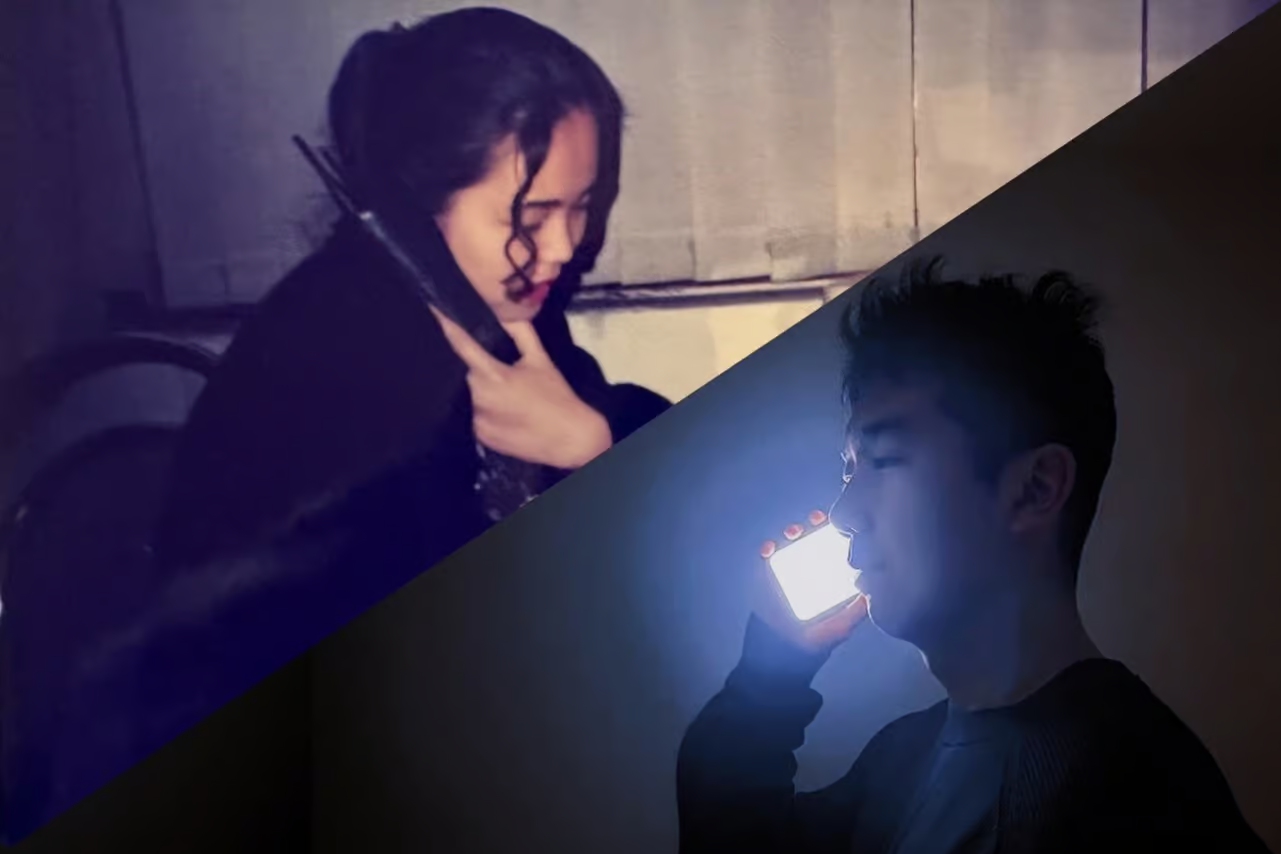
Talking with a 1990s Call-in Show turns a private collection of late-night radio cassettes into a voice-led encounter with Shenzhen’s recent past. Rather than presenting the archive as a searchable database, the project asks what changes when a listener can call, speak, and receive a response shaped by a broadcaster’s recorded voice and writing.
A voice from a migrant city
The project begins with A Break at Service Station, a late-night call-in program broadcast on Shenzhen FM 89.8 in 1993–94. Sophie’s advice, stories, music, and conversations accompanied young professionals and migrant workers during a period of rapid urban change.
Building memory from sound and writing
Thirty-eight cassette recordings—about forty hours of broadcasts—were digitized, transcribed, and indexed. Nearly 60,000 Chinese characters from Sophie’s essays, reviews, and criticism extend the archive beyond the surviving audio and help define the boundaries of the reconstructed persona; public use of the written archive, broadcast recordings, and voice was authorized by radio host Xiaoqing “Sophie” Xi.
From speech to response
Vosk transcribes the listener’s question; retrieval and role-specific prompts connect it with the indexed archive; an OpenAI language model generates a response; and GPT-SoVITS synthesizes Sophie’s voice. Sentence-level parallel processing reduced the wait for the first spoken reply to roughly five to ten seconds.
Calling rather than searching
The mobile interface resembles an FM radio tuned to 89.8, with a slider that opens a one-to-one call. The voice-only encounter recalls the intimacy of late-night broadcasting and allows memory to surface through conversation instead of a conventional timeline or searchable database.
Listening to participant responses
Early participants described the voice as warm and comforting, compared past and present styles of communication, and recalled relatives who had worked in Shenzhen. Their responses suggest that the system mediates personal and collective memory rather than simply demonstrating voice-cloning technology.
Cultural memory and ethical distance
AI does not recover Sophie exactly or create new history; it recombines a deliberately bounded archive into an interpretive persona. Keeping the sources, permissions, and distance from the real person visible is essential. The project also asks which ordinary messages and recordings from today may become meaningful archives in the future.
Interview
From Cassette to Code
In this official ACM SIGGRAPH Blog interview, Fan Xiang and Tongge Yu discuss how archival radio recordings, written memories, and AI became a conversational encounter with 1990s Shenzhen.
Conversation
The interview accompanies the Art Papers project Talking to the Midnight Broadcast: Reviving 1990s City Memories With AI.